Toggle light / dark theme

For $150,000 you can now order your own Hoverbike

Circa 2018


After first spotting this crazy looking motorcycle-styled hoverbike in early 2017, we were skeptical the contraption would ever move beyond just an odd engineering curiosity. However, Russian company Hoversurf has just revealed its hoverbikes are now ready for production and preorders are open, with delivery scheduled for sometime in 2019.

Ever since the Scorpion hoverbike was revealed we seriously questioned its safety, with such a crazy close proximity between spinning blades and fleshy legs it seemed like a device only really suitable for “aspiring amputees”. Nevertheless, Hoversurf has rapidly moved from ambitious prototype to commercial aircraft, first revealing a deal to sell the aircraft to Dubai Police, and then more recently passing the US Federal Aviation Administration requirements to be classified as a legal ultralight vehicle.

The plan to classify the hoverbike as an ultralight vehicle resulted in some minor design tweaks to fulfill the legal requirements of the classification, but this final commercial iteration is still, at its core, the same crazy quadcopter hoverbike.

Flight of an aeroplane with solid-state propulsion

Circa 2018


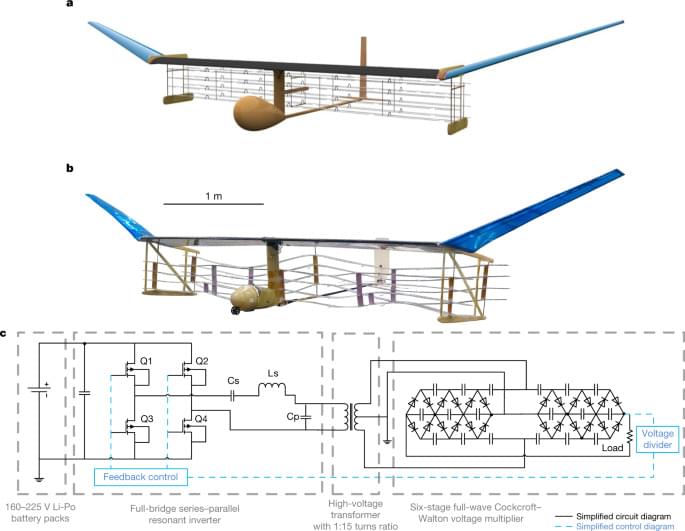
Since the first aeroplane flight more than 100 years ago, aeroplanes have been propelled using moving surfaces such as propellers and turbines. Most have been powered by fossil-fuel combustion. Electroaerodynamics, in which electrical forces accelerate ions in a fluid1,2, has been proposed as an alternative method of propelling aeroplanes—without moving parts, nearly silently and without combustion emissions3,4,5,6. However, no aeroplane with such a solid-state propulsion system has yet flown. Here we demonstrate that a solid-state propulsion system can sustain powered flight, by designing and flying an electroaerodynamically propelled heavier-than-air aeroplane. We flew a fixed-wing aeroplane with a five-metre wingspan ten times and showed that it achieved steady-level flight. All batteries and power systems, including a specifically developed ultralight high-voltage (40-kilovolt) power converter, were carried on-board. We show that conventionally accepted limitations in thrust-to-power ratio and thrust density4,6,7, which were previously thought to make electroaerodynamics unfeasible as a method of aeroplane propulsion, are surmountable. We provide a proof of concept for electroaerodynamic aeroplane propulsion, opening up possibilities for aircraft and aerodynamic devices that are quieter, mechanically simpler and do not emit combustion emissions.

This is how India can become the next Silicon Valley

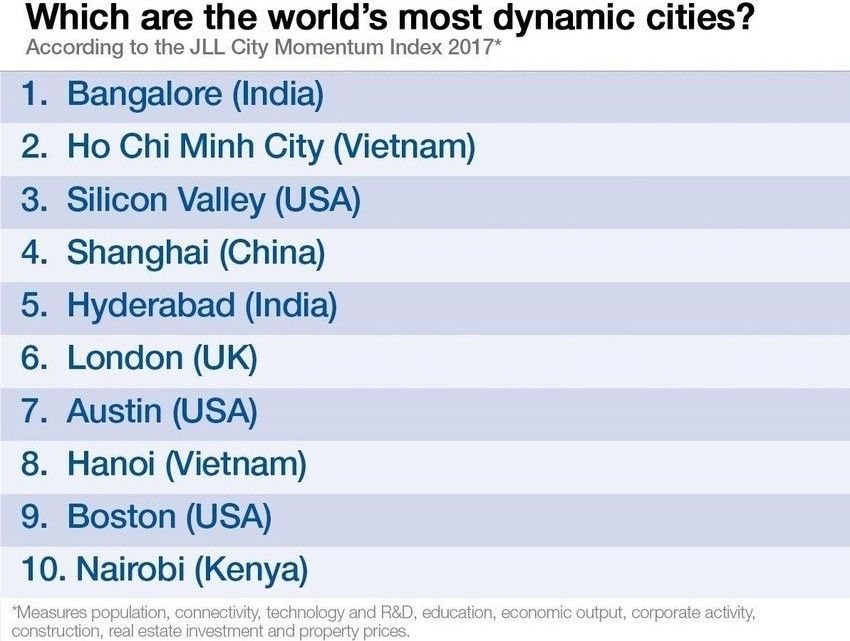
If India can continue to develop its urban centres and promote a Silicon Valley spirit of entrepreneurship, it could be in a prime position to achieve global tech hub status. Bengaluru (formerly Bangalore) in the south and Gurgaon in the north are two tech-savvy cities emblematic of India’s rapid urbanization. The country is set to become the largest contributor to the world’s urban population.


India has long branded itself as the world’s leading outsourcing destination for global companies, particularly for those in the technology sector — but in the Fourth Industrial Revolution, the time is ripe for the world’s most populous country to reinvent itself.

There is a burgeoning start-up and innovation culture, as shown by the Global Innovation Index, where India has improved its ranking from 81 to 52 between 2015 and 2019. In addition, the country has improved its reputation in terms of the risk posed to foreign investments and, in 2019, ranked third in the world in terms of attracting investment for technology transactions.

To maintain this momentum, India needs to further improve government regulations to encourage support for technological innovation, train tech talent and incentivize it to stay in the country and continue to improve its risk profile by attracting significant foreign and domestic investment in technology. Provided these favourable conditions can be met, India has unmatched potential to become the world’s next Silicon Valley.

‘The next era of human progress’: what lies behind the global new cities epidemic?

This new breed of city takes various different forms, from government initiatives, to public-private partnerships, to entirely private enterprises. Many are being used to jump-start economies in the developing world, with masterplans carefully calibrated to attract foreign investors and treasuries looking to sink their funds into something concrete. They provide a powerful means for wealthy countries to expand their strategic influence abroad, with the construction of new cities acting as a form of “debt-trap diplomacy”, tying host nations into impossibly burdensome deals. They are billed as a panacea for the world’s urban ills, solving overcrowding, congestion and pollution; yet, more often than not, they turn out to be catalysts for land dispossession, environmental degradation and social inequality.


The feature Kim enjoys most is a small touchscreen display on his kitchen wall that allows him to keep track of his and his wife’s consumption of electricity, water and gas and, most important, compare it against the average statistics for the building. Flicking between the screens of bar charts and graphs, a broad grin spreads across his face: for yet another day running, they are more energy-efficient than all their neighbours.

From their living room window at the top of one of the city’s new residential towers, a panorama of downtown Songdo unfolds. Across an eight-lane highway lies Central Park, a broad swath of trees surrounding an ornamental lake, flanked by rows of glass towers with vaguely jaunty silhouettes. Armies of identikit concrete apartment blocks march into the hazy distance beyond, terminating at a Jack Nicklaus-designed golf course. It looks a lot like many other modern Asian cities, a place of generic towers rising above a car-dominated grid. Public life is mostly confined to the air-conditioned environments of malls and private leisure clubs.

Initiated by the South Korean government in the late 1990s, when Incheon airport was being planned, Songdo represents a model that has been replicated numerous times around the world. Begun as a joint venture with US developer Gale International – which has since hawked its “city in a box” kit to other countries – the Songdo International Business District was conceived as a $40bn hub for international companies, an exemplar of sustainable urbanism and testing ground for new smart city technologies.

Are You Developing Skills That Won’t Be Automated?

The jobs that are likely to be automated are repetitive and routine. They range from reading X-rays (human radiologists may soon have much more limited roles), to truck driving, to stocking a warehouse. While much has been written about the sorts of jobs that are likely to be eliminated, another perspective that has not been examined in as much detail is to ask not which jobs will be eliminated but rather which aspects of surviving jobs will be replaced by machines.


The future of work looks grim for many people. A recent study estimated that 10% of U.S. jobs would be automated this year, and another estimates that close to half of all U.S. jobs may be automated in the next decade. The jobs that are likely to be automated are repetitive and routine. They range from reading X-rays, to truck driving, to stocking a warehouse. In this context, employers say that they’re seeking candidates who have other sorts of “soft skills,” such as being able to learn adaptively, to make good decisions, and to work well with others. These sought-after abilities, of course, fit perfectly with the sorts of things that people can do well, but are and will continue to be difficult to automate. All of this suggests that our educational systems should concentrate not simply on how people interact with technology (e.g., by teaching students to code), but also how they can do the things that technology will not be doing soon. These are the skills that are hardest to understand and systematize, and the skills that give — and will continue to give —humans an edge over robots.

/* */