In 2013, I interviewed a man who studies cyborgs and war for a living.
Somewhere in that conversation, Prof. Chris Hables Gray predicted a global pandemic. I chimed in that it would most likely stem from a bird flu outbreak.
We were both right. Neither of us wanted to be.
That was six years before COVID. And here we are in 2026, watching H5N1 headlines pile up again.
The point was never the prediction. The point was what he said we should do about it.
Chris did not pitch a gadget. He did not sell a forecast. He argued that surviving the century is not a technology problem; it is a citizenship problem.
A chilling wave of online theories erupted after viral posts claimed Google’s experimental Willow quantum chip may have detected “something watching us.” The internet quickly exploded with speculation involving parallel universes, hidden dimensions, cosmic observers, simulation theory, and artificial intelligence uncovering realities beyond human understanding. But what’s actually true behind the headlines?
Google’s quantum computing research focuses on developing advanced processors capable of solving highly specialized problems using qubits, superposition, and quantum entanglement. These systems operate according to the strange laws of quantum mechanics, where particles can behave in ways that often sound almost impossible from a normal human perspective.
The viral controversy appears to have grown from misunderstandings surrounding discussions of quantum interference, error correction behavior, and theoretical interpretations of quantum physics such as the “many-worlds interpretation.” Some internet users exaggerated these highly technical concepts into claims that quantum computers were interacting with external intelligences or hidden observers.
In reality, there is currently no scientific evidence that Google’s Willow chip discovered conscious entities, surveillance from another dimension, or anything literally “watching humanity.” Physicists say many sensational headlines confuse legitimate quantum phenomena with speculative science fiction ideas that become distorted across social media.
However, the science itself is still fascinating. Quantum experiments often reveal behaviors that challenge ordinary intuition, including entanglement, probabilistic outcomes, observer effects, and interference patterns that remain deeply debated even among physicists. Some interpretations of quantum mechanics suggest reality may operate in ways far stranger than classical physics once imagined — though none prove supernatural observation or cosmic consciousness.
In this video, we break down what the Willow quantum chip is actually designed to do, how quantum computers really work, and why modern quantum physics often gets misrepresented online. We’ll also explore qubits, superposition, observer effects, many-worlds theory, simulation hypotheses, AI-assisted physics research, and the growing race to build next-generation quantum systems.
It should feel dated by now. It doesn’t. It feels like a prophecy.
Back in 2013, Dr. Ann Cavoukian sat down with me as the Information and Privacy Commissioner of Ontario and the mind behind Privacy by Design. She told me privacy was not dead. She told me security and freedom were not a trade-off. She told me metadata reveals more about you than the content ever could.
Then she said something I have never been able to shake:
“We have to protect privacy globally, or we protect it nowhere.”
Think about where we are now. Surveillance is the business model. Your data trains systems you will never see. The “nothing to hide” crowd got louder, and the borders she warned about got thinner. She saw all of it coming.
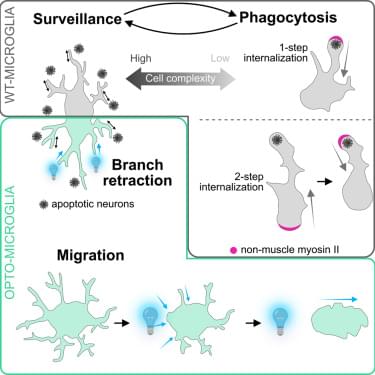
Biermeier et al. use live imaging in zebrafish to show that microglia alternate between distinct morphological states that support brain surveillance and phagocytosis. By optogenetically controlling cytoskeletal contractility, they demonstrate programmable, reversible control of microglial behavior in the living brain.
In December 2025, TechCrunch reported that SIO was behind a set of malicious Android apps that masqueraded as WhatsApp and other popular apps but stole private data from a target’s device using a spyware family called Spyrtacus. The apps are believed to have been used by a government customer to target unknown victims in Italy.
SIO is one of the many Italian companies selling surveillance tools, including Cy4Gate, eSurv, GR Sistemi, Negg, Raxir, and RCS Lab, turning the country into a “spyware hub.”
Early last year, WhatsApp alerted around 90 users that they were targeted with Paragon Solutions’ spyware known as Graphite. Then, in August 2025, it notified less than 200 users who may have been targeted as part of a sophisticated campaign by chaining together zero-day vulnerabilities in iOS and the messaging app.
North Korean hackers are deploying newly uncovered tools to move data between internet-connected and air-gapped systems, spread via removable drives, and conduct covert surveillance.
The malicious campaign has been named Ruby Jumper and is attributed to the state-backed group APT37, also known as ScarCruft, Ricochet Chollima, and InkySquid.
Air-gapped computers are disconnected from external networks, especially the public internet. Physical isolation is achieved at the hardware level by removing all connectivity (Wi-Fi, Bluetooth, Ethernet), while logical segregation relies on various software-defined controls, like VLANs and firewalls.
Scientists from the National University of Singapore (NUS) have developed a biochemical technique that captures fleeting “handshakes” between newly made proteins and the cellular helpers. These short interactions are important because they can determine whether a protein turns out healthy and useful or is faulty and in need of removal. The research has been published in the journal Molecular Cell.
Cells produce vast numbers of proteins to sustain life. But building a protein is not only about assembling a chain of amino acids in the right order. As the protein chain is being produced, it must begin folding into the correct three-dimensional shape and avoid attaching to the wrong partners.
When folding goes wrong, misfolded proteins can become sticky, clump together, and disrupt cellular health. Cells reduce this risk by running “quality checks” even while proteins are still being made. However, identifying the key players in this early surveillance has been challenging because their interactions with newly forming protein chains are brief and easily missed.
A previously undocumented set of 23 iOS exploits named “Coruna” has been deployed by multiple threat actors in targeted espionage campaigns and financially motivated attacks.
The Coruna kit contains five full iOS exploit chains, the most sophisticated leveraging non-public techniques and mitigation bypasses, for iOS versions 13.0 through 17.2.1 (released in December 2023).
Google Threat Intelligence Group (GTIG) researchers first observed activity related to the Coruna exploit kit in February 2025, in activity attributed to a surveillance vendor customer.