Toggle light / dark theme

Memristor Devices Could Power the Next Generation of Neuromorphic Computers

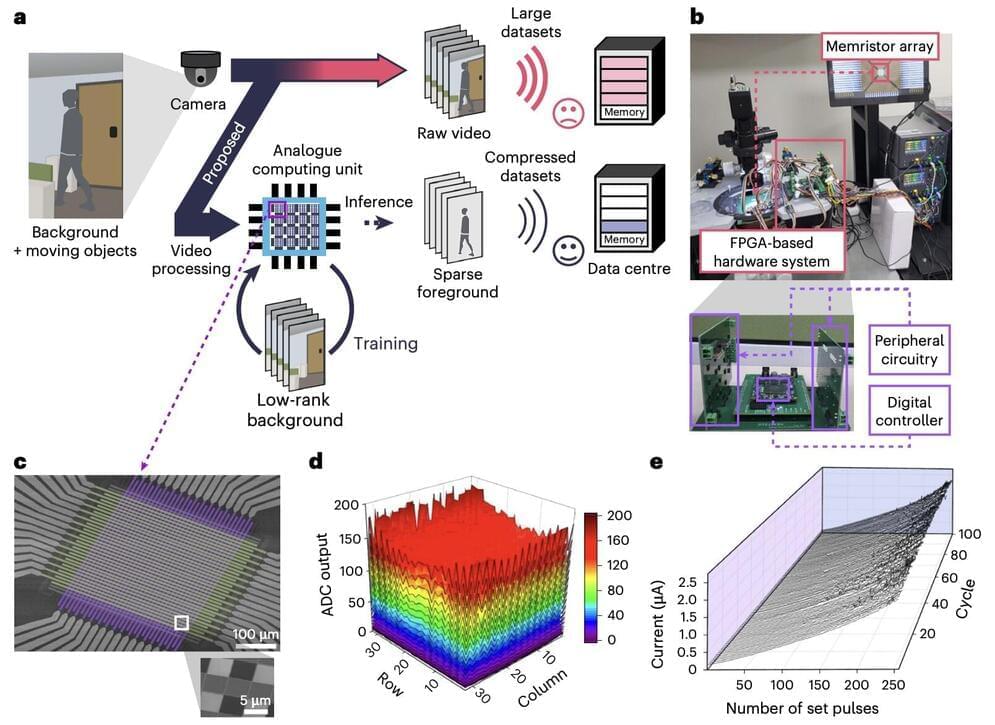
A novel device consisting of metal, dielectric, and metal layers remembers the history of electrical signals sent through it. This device, called a memristor, could serve as the basis for neuromorphic computers-;computers that work in ways similar to human brains. Unlike traditional digital memory, which stores information as 0s and 1s, this device exhibits so-called “analog” behavior. This means the device can store information between 0 and 1, and it can emulate how synapses function in the brain. Researchers found that the interface between metal and dielectric in the novel device is critical for stable switching and enhanced performance. Simulations indicate that circuits built on this device exhibit improved image recognition.

The Impact

Today’s computers are not energy efficient for big data and machine learning tasks. By 2030, experts predict that data centers could consume about 8% of the world’s electricity. To address this challenge, researchers are working to create computers inspired by the human brain, so-called neuromorphic computers. Artificial synapses created with memristor devices are the building blocks of these computers. These artificial synapses can store and process information in the same location, similar to how neurons and synapses work in the brain. Integrating these emergent devices with conventional computer components will reduce power needs and improve performance for tasks such as artificial intelligence and machine learning.

DNA to AI: How Evolution Shapes Smarter Algorithms

Summary: A new AI algorithm inspired by the genome’s ability to compress vast information offers insights into brain function and potential tech applications. Researchers found that this algorithm performs tasks like image recognition and video games almost as effectively as fully trained AI networks.

By mimicking how genomes encode complex behaviors with limited data, the model highlights the evolutionary advantage of efficient information compression. The findings suggest new pathways for developing advanced, lightweight AI systems capable of running on smaller devices like smartphones.

Alien Civilizations May Have Already Formed a New Kind of AI-Based Consciousness, Scientists Say

We may not be the only beings in the universe who use artificial intelligence. That’s according to some astronomers who say that an intelligent civilization anywhere in the cosmos would develop this tool naturally over the course of their cultural evolution.

After 13.8 billion years of existence, life has likely sprung up countless times throughout the cosmos. According to the Drake Equation, which calculates the probability of an existing, communicating civilization, there are currently an estimated 12,500 such intelligent alien societies in the Milky Way Galaxy alone. And if there are aliens who think in a way that we do, and created cultures that developed technology like us, then they probably invented a form of artificial intelligence, too, scientists say.

Assuming AI has been an integral part of intelligent societies for thousands or even millions of years, experts are increasingly considering the possibility that artificial intelligence may have grown to proportions we can scarcely imagine on Earth. Life in the universe may not only be biological, they say. AI machine-based life may dominate many extraterrestrial civilizations, according to a burgeoning theory among astrobiologists.

Ed Boyden — The Future of Humanity | Xapiens Symposium

This is the first symposium of Xapiens at MIT — “The Future of Homo Sapiens”

The future of our species will be majorly influenced by the technical advancements and ethical paradigm shifts over the next several decades. Artificial intelligence, neural enhancement, gene editing, solutions for aging and interplanetary travel, and other emerging technologies are bringing sci-fi’s greatest ideas to reality.

Sponsored by the MIT media lab and the MIT mcgovern institute of brain research.

Full Agenda:

- Openings remarks from Joe Paradiso — https://youtu.be/9bG40ySgE8I
A.W Dreyfoos Professor and Associate Academic Head of Media Arts and Sciences at MIT Director of the Responsive Environments Group.

- Pattie Maes — https://youtu.be/b-16PW9RvJc.

/* */