Toggle light / dark theme

Acoustically activatable liposomes as a translational nanotechnology for site-targeted drug delivery and noninvasive neuromodulation

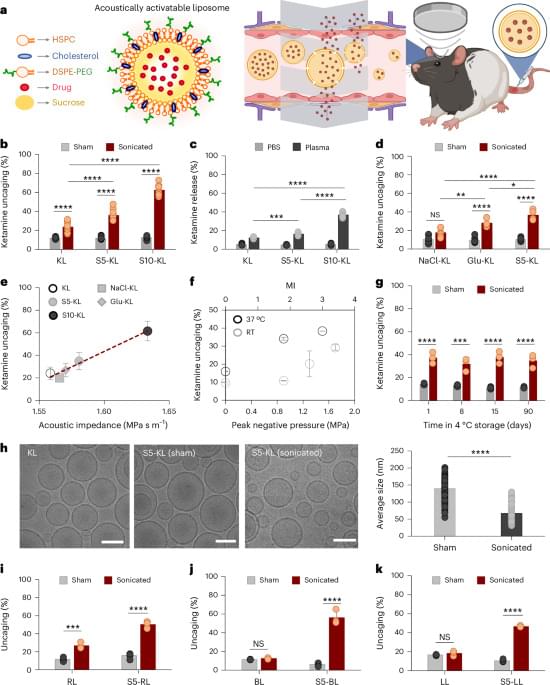
Purohit et al. incorporate sucrose into drug-loaded lipid nanoparticle (LNP) formulations, which shifts the acoustic impedance in a way that triggers drug release upon exposure to focused ultrasound (FUS). By using FUS to both transiently open the blood-brain-barrier and to release drugs from their LNPs, various drugs were delivered into the brains of mice.


Acoustically activatable nanocarriers made by incorporating 5% sucrose into liposomes release drug with low-intensity ultrasound, providing a readily clinically translatable system for both central and peripheral noninvasive neuromodulation.

Bioreducible Gene Delivery Platform that Promotes Intracellular Payload Release and Widespread Brain DispersionClick to copy article linkArticle link copied!

We here introduce a novel bioreducible polymer-based gene delivery platform enabling widespread transgene expression in multiple brain regions with therapeutic relevance following intracranial convection-enhanced delivery. Our bioreducible nanoparticles provide markedly enhanced gene delivery efficacy in vitro and in vivo compared to nonbiodegradable nanoparticles primarily due to the ability to release gene payloads preferentially inside cells. Remarkably, our platform exhibits competitive gene delivery efficacy in a neuron-rich brain region compared to a viral vector under previous and current clinical investigations with demonstrated positive outcomes. Thus, our platform may serve as an attractive alternative for the intracranial gene therapy of neurological disorders.

Air pollution and Parkinson’s: What a 292,000-person study reveals about hidden risks

Researchers in Northern Ireland examined whether exposure to fine particulate matter (PM2.5) and nitrogen dioxide (NO₂) increases the risk of Parkinson’s disease. While no overall link was found after adjusting for confounders, younger adults under 50 showed a modest association with PM2.5, raising questions about age-related susceptibility and diagnostic misclassification.

How do you trust a robot you’ve never met?

Many of the environments where human-facing universal robots can provide benefits — homes, hospitals, schools — are sensitive and personal. A tutoring robot helping your kids with math should have a track record of safe and productive sessions. An elder-care assistant needs a verifiable history of respectful, competent service. A delivery robot approaching your front door should be as predictable and trustworthy as your favorite mail carrier. Without trust, adoption will never take place, or quickly stall.

Trust is built gradually and also reflects common understanding. We design our systems to be explainable: multiple AI modules talk to each other in plain language, and we log their thinking so humans can audit decisions. If a robot makes a mistake — drops the tomato instead of placing it on the counter — you should be able to ask why and get an answer you can understand.

Over time, as more robots connect and share skills, trust will depend on the network too. We learn from peers, and machines will learn from us and from other machines. That’s powerful but just like parents are concerned about what their kids learn on the web, we need good ways to audit and align skill exchange for robots… Governance for human–machine societies isn’t optional; it’s fundamental infrastructure.

Why AI Companies Are Racing to Build a Virtual Human Cell

Virtual cells could make it faster and easier to discover new drugs. They could also give insight into how cancer cells evade the immune system, or how an individual patient might respond to a given therapy. They might even help basic scientists come up with hypotheses about how cells work that can steer them toward what experiments to do with real cells. “The overall goal here,” Quake says, “is to try to turn cell biology from a field that’s 90% experimental and 10% computational to the other way around.”

Some scientists question how useful predictions made by AI will be, if the AI can’t provide an explanation for them. “The AI models, normally, are a black box,” says Erick Armingol, a systems biologist and post-doctoral researcher at the Wellcome Sanger Institute in the U.K. In other words, they give you an answer, but they can’t tell you why they gave you that answer.

Scientists build artificial neurons that work like real ones

There are a wide range of applications for Fu and Yao’s new neuron, from redesigning computers along bio-inspired, and far more efficient principles, to electronic devices that could speak to our bodies directly.

“We currently have all kinds of wearable electronic sensing systems,” says Yao, “but they are comparatively clunky and inefficient. Every time they sense a signal from our body, they have to electrically amplify it so that a computer can analyze it. That intermediate step of amplification increases both power consumption and the circuit’s complexity, but sensors built with our low-voltage neurons could do without any amplification at all.”

The secret ingredient in the team’s new low-powered neuron is a protein nanowire synthesized from the remarkable bacteria Geobacter sulfurreducens, which also has the superpower of producing electricity. Yao, along with various colleagues, have used the bacteria’s protein nanowires to design a whole host of extraordinary efficient devices: a biofilm, powered by sweat, that can power personal electronics; an “electronic nose” that can sniff out disease; and a device, which can be built of nearly anything, that can harvest electricity from thin air itself.

Large Genetic Study Links Cannabis Use to Psychiatric, Cognitive and Physical Health

“Cannabis is widely used, but its long-term effects on health remain poorly characterized,” said Sandra Sanchez-Roige, Ph.D., associate professor of psychiatry at UC San Diego School of Medicine and senior author of the study. The researchers were also interested in the relationship between genetics and traits that contribute to the development of cannabis use disorder, which can interfere with a person’s daily life.

“While most people who try cannabis do not go on to develop cannabis use disorder, some studies estimate that nearly 30% will,” said Sanchez-Roige. “Understanding the genetics of early-stage behaviors may help clarify who is at greater risk, opening the door to prevention and intervention strategies.”

The research team conducted a genome-wide association study (GWAS) analyzing relationships between cannabis use and genetic data provided by 131,895 23andMe research participants. They answered survey questions about whether or not they had ever used cannabis, and those who answered yes were also asked how frequently they used the drug.

“We’ve known for decades that genetic factors influence whether or not people will try drugs, how frequently they use those drugs, and the risk that they will become addicted to them,” said Abraham A. Palmer, Ph.D., professor and vice chair for basic research in the department of psychiatry at UC San Diego School of Medicine and co-author of the study. “Genetic tools like GWAS help us identify the molecular systems that connect cannabis use to brain function and behavior.”

“ — —


New research has found genetic associations between cannabis use and psychiatric, cognitive, and physical health. The findings could inform prevention and treatment strategies for cannabis use disorders.

/* */